Grief and Nature
How Outdoor Therapy can help grievers to grieve

As a grief counsellor and an outdoor therapist, of course I’m going to find ways to combine the two, but do you know what? I really don’t have to try too hard as it happens pretty naturally (excuse the pun…). I often describe my outdoor space as being a warm hug from nature, and a warm hug is often what we need when we’re consumed with grief. We can’t fix the grief and make it go away, but there is something powerful in me literally walking alongside you and witnessing that grief in all its many forms. Outdoor Therapy has so much to offer everybody, and that includes those grieving…

Being in my outdoor space is like a hug from nature and gives us change to pause and be present @Jules Lowe Counselling
A chance to pause and be present
We humans love to ruminate, to mull over past incidents and analyse what could have been done differently. As a counsellor, I believe it can be really helpful to be curious about how the past may have informed our present way of thinking and behaving. However, if we’re not careful we can get stuck in thinking about how things could have been different, and find ourselves constantly thinking about it. This can especially be the case when grieving, as our brain desperately tries to make sense of what has happened and often work out ways we could have changed it (sound familiar? Check out my Guilt and Grief Blog).
Recent research* suggests that we are less likely to ruminate when we are in nature. There’s more to notice and bring you into the present moment. The sights, sounds and smells all work can all work together to ensure that we are in the here and now, and that in this moment we are safe. Nature also gives us a chance to pause. Detached from the hustle and bustle of daily life, everything feels slower in the woods. Trees and plants slowly grow, water gently flows and wildlife unassumingly get on with their day. We can be reminded that life doesn’t have to be chaotic, and it can give our brains a well-needed break from ruminating on the past and worrying about the future.
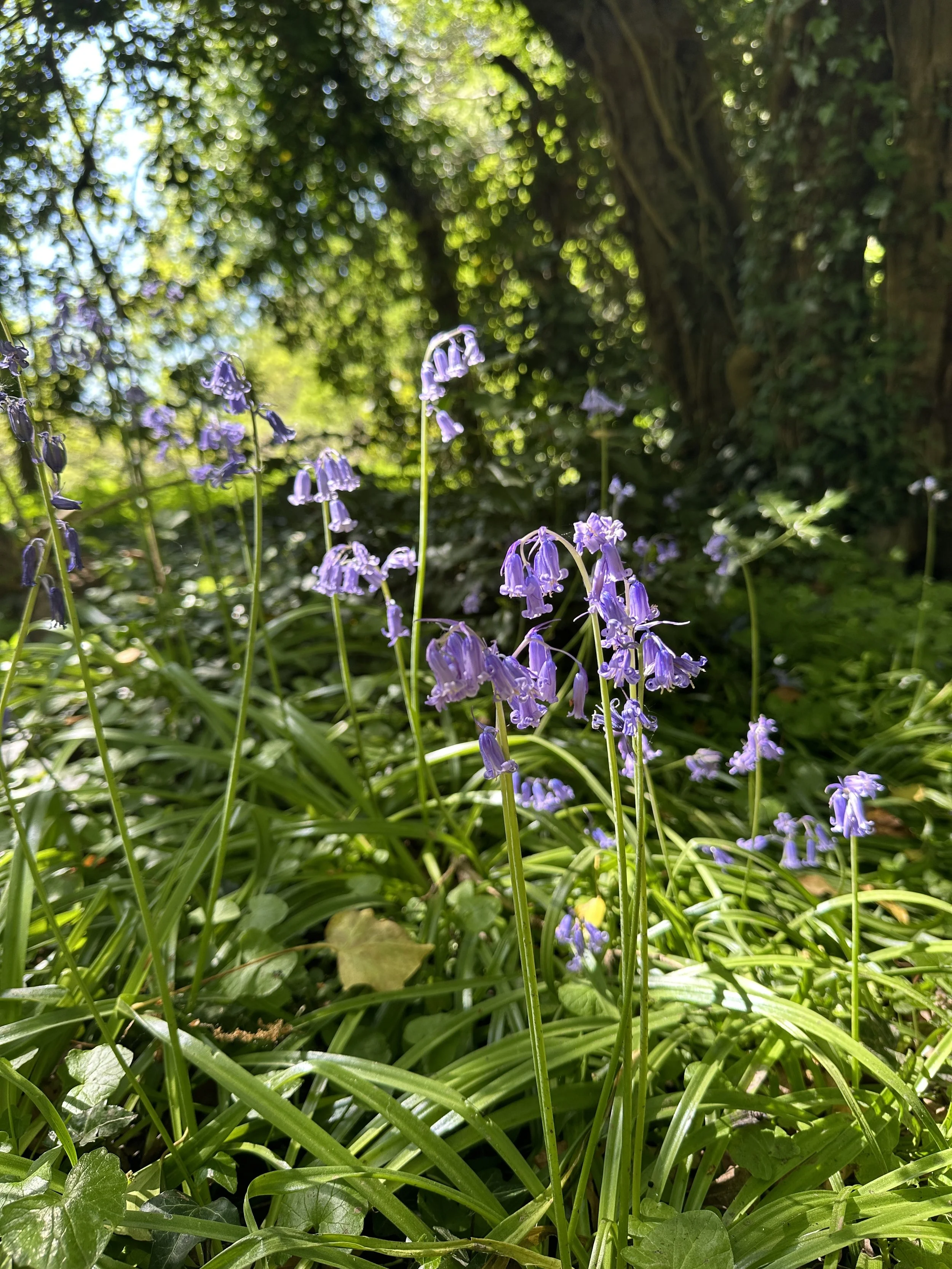
Bluebells are probably not thinking about growing, they just do it - quietly, delicately and gloriously @Jules Lowe Counselling
We’re reminded that change is natural (even if its hard)
Every single week I turn up to my outdoor space and notice something new – the ground may be wet from recent rain, mushrooms may have grown, and now that Spring is on its way everything seems to be bursting into life. Change can feel hard, especially when we didn’t want the change to happen and especially if we had no warning about it, but nature can gently remind us that life carries on. Whatever your beliefs, it can give us a sense that we are part of something bigger.
Whether we want it or not, we will continue to grow around the grief, and nature can help us to hold that grief while reminding us that we are still alive and still growing. Whereas this idea of growth around grief can sometimes add pressure to find something meaningful from something tragic, nature reminds us that there’s no need for this pressure – that growth can be slow and cautious and we can still blossom. After all, I’m curious as to whether the bluebells are wondering why they are growing – they just are.
Death is quietly present and accepted
Again, whether we like it or not, death is part of life, and whereas these days most death is hidden away in hospitals and hospices, in nature nobody comes to tidy it up. There are reminders of death all around, from fallen leaves in the Autumn to rotting tree trunks giving life to all manner of fungi and minibeasts. We humans are so desperate to hide death away, almost like if we don’t talk about or acknowledge it, it won’t happen to us. But for those of us grieving, death is very real, and we want to talk about it. We want to give it space and talk freely about our loved one, rather than feel like we can’t talk about it for fear of upsetting those around us. There is something about death just being present in nature, it just *is*, that can help us to open up – death talk is welcome not hidden away here.

The whirlpool of grief is often used to describe how disorientating grief can feel @Jules Lowe Counselling
Nature as an extra therapist
Being out in nature is so beneficial for our health in so many ways, but it also gives us lots of helping hands when it comes to therapy itself. For a start, if we’re walking and talking, some suggest that the rhythmic movement using both our left and right sides can help us to process what we’re saying better (much like bilateral stimulation is used in EMDR – but don’t worry if you have no idea what this means!). Then there’s all the rich metaphors just waiting to be used. For instance, the waterfalls and flowing water in my outdoor space prove as perfect ways to demonstrate the whirlpool of grief (except we absolutely do not get into the water!). And sometimes the metaphors just appear at exactly the right time, like when a client and I watched a duck swimming along and minding its own business and then hitting a sheet of ice on the water. The duck looked knocked back – just like a sudden death it didn’t see it coming – but then worked on a way to carry on swimming by waddling over the icy patch first – just like we may have to tread carefully at first when grieving.
There’s so much more I can say on the subject, and lots more I know is yet to be discovered, but that’s part of the joy of working outdoors. Walking alongside grievers and giving them space to grieve in nature feels really special, so if you’d like to give it a go, I’m here ready and waiting in my walking boots!
*Research on rumination in nature and lots more in Willis, K. (2024) Good Nature, Tonic